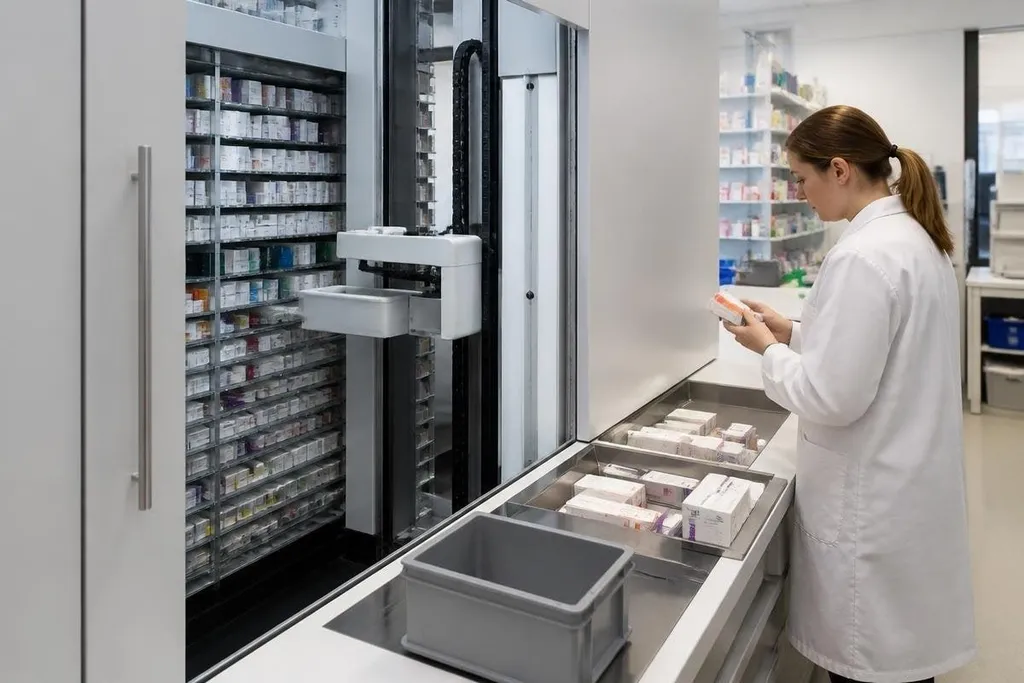
A pharmacy robot can store medicines, read a prescription, pick the right pack, and send it to a pharmacist for checking. That changes where staff spend their time, which helps explain why more pharmacies are looking at robotic systems.
- Robots handle repeat picking and stock tasks.
- Pharmacists still check the prescription and final supply.
- The hard part is fitting the robot to the pharmacy’s layout and rules.
The work robots can handle
Pharmacy robots work best on tasks with clear steps and repeat results. A system may scan a medicine barcode, find its storage location, move the pack, and record the change in stock software.
That record matters because pharmacy staff need to know what is available, what has been picked, and what needs reordering. The system can keep those actions in one place while staff deal with prescriptions that need human judgment.
Some systems use shelves, bins, conveyors, or robotic arms. The design depends on the pharmacy’s floor space, the types of medicine it stores, and the way prescriptions arrive. A hospital pharmacy has different needs from a high-street pharmacy serving people at a counter.
The robot also works inside a set process. A prescription enters the pharmacy system, the software checks the requested medicine, and the robot retrieves a pack or prepares a dose. A pharmacist then checks the medicine, label, and patient details before it leaves the pharmacy.
Why pharmacies are looking at automation
Repeat work takes time. Counting packs, finding stock, filling drawers, and moving medicines between storage and the counter can take staff away from patient questions and clinical work.
Part of that routine flow can move to the robot. The gain comes from the handoff: staff spend less time searching for stock, while the system records where the medicine went and what remains.
Space is another reason. Some pharmacy robots store medicines in a compact area and use software to find each item. That can reduce the need for long rows of open shelves, though the machine still needs room for loading, service access, and safe staff movement.
Cost also shapes the decision. A pharmacy has to pay for the robot, software, installation, training, maintenance, and changes to its current process. The value depends on the number of prescriptions, the range of medicines, local rules, and the cost of staff time.
Prescription volume and staff time set the price case, but a buyer also needs to know what the robot can handle in daily work. Reports on pharmacy robotics systems can place the task, price, and staff role beside the machine’s limits.
Where pharmacy robots still struggle
Known items and set instructions suit the robot well. It has a harder time with damaged packaging, a missing barcode, a medicine stored in the wrong place, or a prescription that needs a change.
Those cases need a person. Staff must also manage stock that needs special storage, medicines with short expiry dates, and products that cannot follow the pharmacy’s normal picking process.
Safety adds another layer. The pharmacy must control who can access medicines, protect patient information, and keep a clear record of every step. A robot does not remove those duties. It adds software, sensors, motors, and service checks that the pharmacy must manage.
Integration can be the slow part. The robot needs to exchange accurate information with the pharmacy system, label printer, stock records, and any system used for prescription checks. A fault in that chain can stop work even when the robot itself is operating normally.
A practical buying check
Before choosing a system, a pharmacy manager should check these points:
- Task fit: list the repeat jobs the robot will handle and the jobs staff will keep.
- Medicine range: check pack sizes, storage needs, expiry dates, and items that need manual handling.
- System links: confirm how prescriptions, stock records, labels, and error messages move between systems.
- Human checks: set the exact point where a pharmacist checks the medicine and patient details.
- Service plan: ask who fixes faults, how quickly parts arrive, and what happens during downtime.
- Payback test: compare the full robot cost with the staff time and floor space it may free.
The strongest case is a pharmacy with a steady flow of repeat work and a process that can be measured before installation. A smaller site may gain more from better storage software or a simpler counting system than from a full robot.
I'd skip a pharmacy robot when the supplier can't show how errors, downtime, and manual exceptions will be handled. The machine earns its place when it removes a clear task and leaves pharmacists with more time for work that needs their judgment.